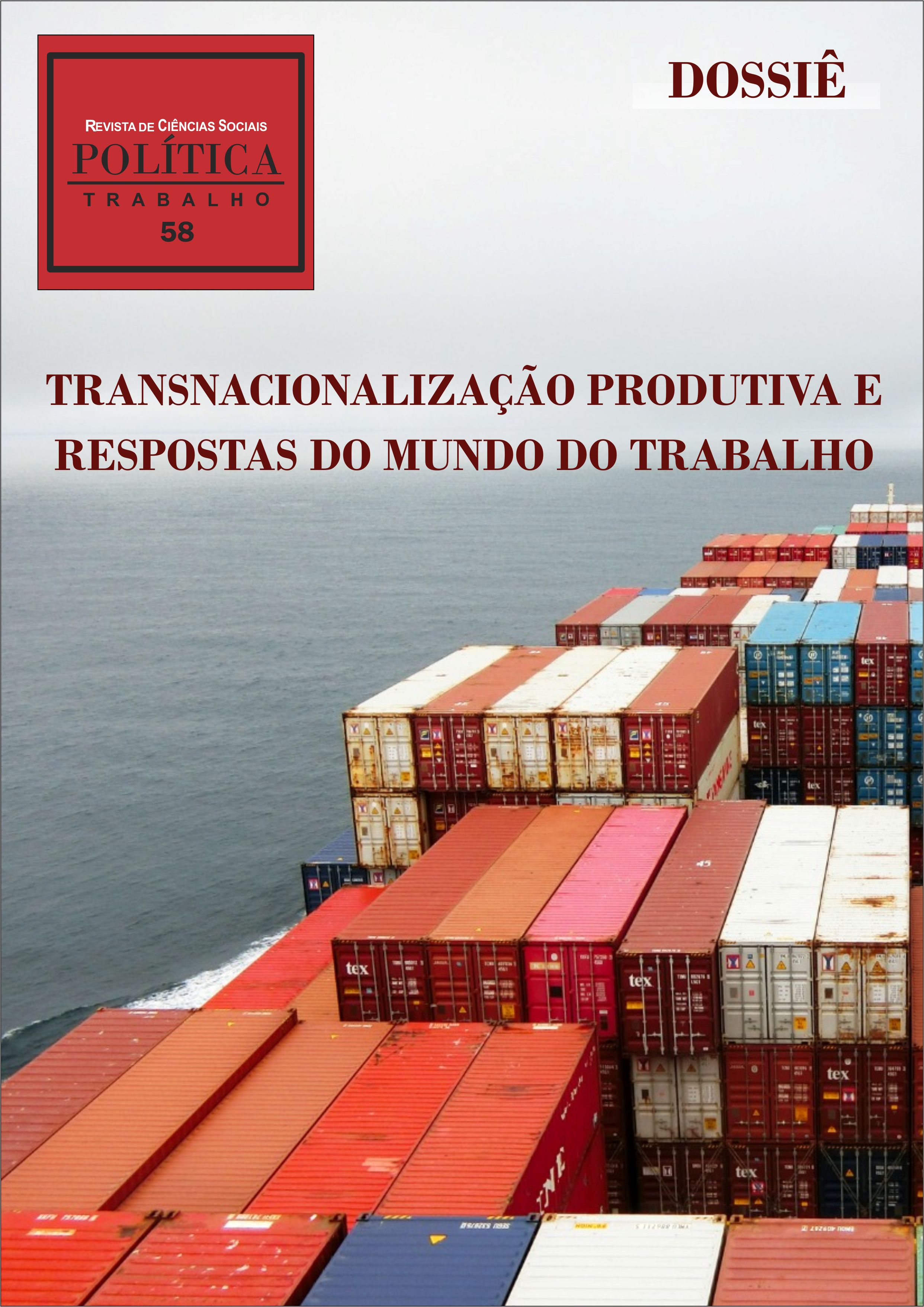
Commodity Traders and Sustainable (Soy) Supply Chains
DOI:
https://doi.org/10.22478/ufpb.1517-5901.2023v1n58.65153Abstract
Global commodity traders play a key role in the purchase-sale, handling and distribution of many of the world’s commodities, thus facilitating trade and consumer demand. Yet they are often criticized for adversely affecting local producers and local communities/cultures and for engaging in (or effectively encouraging) un-sustainable practices and outcomes.
This paper takes a small, initial step in trying to answer these debates. As part of the Governance of Labour and Logistics for Sustainability (GOLLS) program (via an ISS RIF award), it first seeks to describe what these key firms do and how. Using the case of soya and Brazil (in particular), it describes the commodities, the “typical” organizational and financial mechanisms used by traders (for retaining margins) and the case of the key ABCD group of firms.
The specific impacts of soya chain governance (plus acts of resistance and strategies/forms of regulation) are noted more clearly in other publications and events (Pegler et al. forthcoming, Pegler and Widmarck 2020, Vecchione 2018), including quite startling reviews of the role of various nations financial sectors and governments in promoting trader activity (FIAN International et al. 2018).
This article’s second contribution is more general, making the link between trader activity and the broader question of sustainability through comparing and contrasting how profit/volumes and risk assessments surrounding local supply considerations can at times encourage them to either vertically or horizontally integrate (or not) in the local chain/economy. These choices help provide the context to the “spaces” where global chains touch down, these in turn having important consequences for local development, incomes, jobs and welfare and the (above mentioned) social impacts, forms of resistance and regulation which often emerge.
The paper makes an important, albeit initial and exploratory contribution to the GOLLS project question – under what conditions might the logic of “chain drivers and inner (local well- being) drivers” actually meet – i.e. the chain governance and sustainability debate.
Keywords: global production networks, soybean supply chains, commodity trading, sustainability
Published
Issue
Section
License
Copyright (c) 2023 REVISTA DE CIÊNCIAS SOCIAIS - POLÍTICA & TRABALHO

This work is licensed under a Creative Commons Attribution-NonCommercial 4.0 International License.
DIREITOS DE AUTOR: O autor retém, sem retrições dos direitos sobre sua obra. DIREITOS DE REUTILIZAÇÃO: A Revista de Ciências Sociais - Política & Trabalho adota a Licença Creative Commons, CC BY-NC atribuição não comercial conforme a Política de Acesso Aberto ao conhecimento adotado pelo Portal de Periódicos da UFPB. Com essa licença é permitido acessar, baixar (download), copiar, imprimir, compartilhar, reutilizar e distribuir os artigos, desde que para uso não comercial e com a citação da fonte, conferindo os devidos créditos de autoria e menção à Revista de Ciências Sociais - Política & Trabalho. Nesses casos, nenhuma permissão é necessária por parte dos autores ou dos editores. DIREITOS DE DEPÓSITO DOS AUTORES/AUTOARQUIVAMENTO: Os autores são estimulados a realizarem o depósito em repositórios institucionais da versão publicada com o link do seu artigo na Revista de Ciências Sociais - Política & Trabalho.


