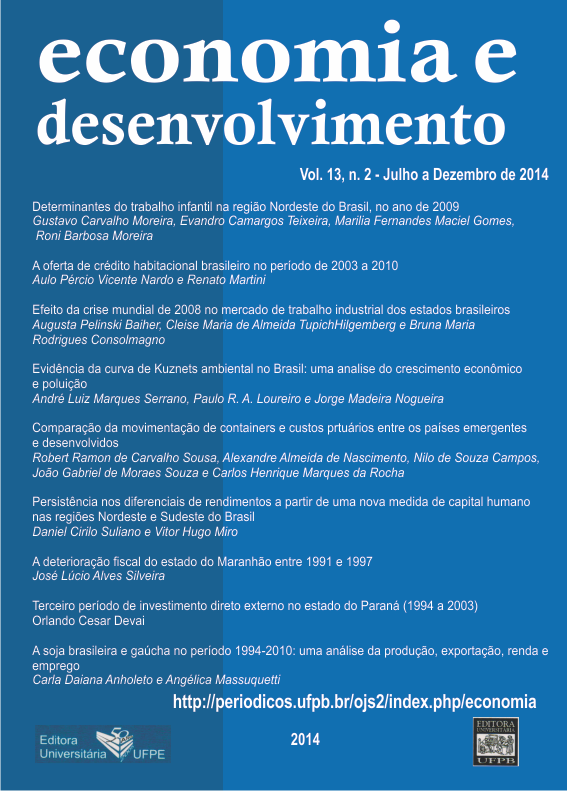
Determinantes do trabalho infantil na região Nordeste do Brasil, no ano de 2009
Palavras-chave:
trabalho infantil, mercado de trabalho, Nordeste.Resumo
Dada a elevada quantidade de crianças trabalhando ilegalmente no país, sendo sua maior incidência na região Nordeste, e considerando suas negativas consequências quanto à educação, saúde e privação do lazer das crianças, tornou-se relevante o estudo desse fenômeno no sentido de analisar as principais características da família e do domicílio que influenciaram a inserção ilegal de crianças no mercado de trabalho, no ano de 2009. Objetivou-se determinar as variáveis socioeconômicas que influenciam em maior magnitude a inserção discriminada de meninos e meninas no mercado de trabalho, comparando os determinantes por gênero. Utilizou-se o modelo logístico multinomial, considerando que as famílias tomam decisões simultâneas na escolha de alocar seus filhos entre estudo e trabalho. Os resultados indicaram como variáveis fundamentais para a inserção de crianças no mercado de trabalho o fato de os pais terem trabalhado na infância, a idade da criança, residir no meio rural e a renda. Comparativamente, ao alocar seus filhos para o mercado de trabalho, e de acordo com as características analisadas, conclui-se que quando as famílias têm recursos limitados e precisam escolher entre educar seus filhos ou filhas, os meninos têm maiores chances de não estudar e trabalhar e estudar e trabalhar.Downloads
Não há dados estatísticos.
Downloads
Publicado
2015-11-23
Como Citar
Moreira, G. C., Teixeira, E. C., Maciel Gomes, M. F., & Moreira, R. B. (2015). Determinantes do trabalho infantil na região Nordeste do Brasil, no ano de 2009. Revista Economia E Desenvolvimento, 13(2). Recuperado de https://periodicos.ufpb.br/index.php/economia/article/view/18440
Edição
Seção
Artigos