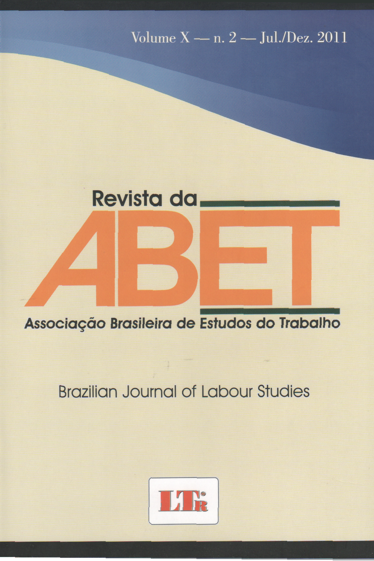
WOMEN'S STRATEGIES TO CONCILIATE PAID LABOR AND CARE IN THE TWENTY-FIRST CENTURY
DOI:
https://doi.org/10.61999/abet.1676-4439.2011v10n2.15600Abstract
This article aims to present the main features of female employment over the last 40 years, in order to stress persistent gender gaps and other gender deficits. In order to do that, we relied on two very consistent international databases on labor market issues, ILO´s (KILM) and OECD´s. Both allowed a cross country analysis on the profile of female employment for more than 20 countries (advanced economies, countries from the developing world and most regions of the world). The results show that women have strongly benefitted from the dynamics of wage relations by the end of the XX century due to the decline of fertility rates and the rise of their human capital. Regressions, whose methodology takes into account the specific traits of each country, acknowledge both factors as the most significant in accelerating female participation in the labor market, the former being the most remarkable. This empirical investigation has brought to light other variables with huge impact on the promotion of female labor activity, even though they vary according to age brackets. The article questions whether these key factors are gradually loosing impact in reducing gender asymmetries in the labor market. It also highlights the emergence of two distinct female occupational strategies: one, first best, and the other, second best, as a consequence of the exhausting of a first generation pattern of women´s participation in the labor market.Downloads
Downloads
How to Cite
Issue
Section
License
Política de Acesso Livre
Esta revista oferece acesso livre imediato ao seu conteúdo, seguindo o princípio de que disponibilizar gratuitamente o conhecimento científico ao público proporciona maior democratização mundial do conhecimento.
Atribuição dos artigos é não comercial (sem derivações 4.0, isto é, Creative Commons) e o acesso é livre e gratuito para download e leitura.
Não há taxa para submissão, avaliação e publicação de artigos.
Copyright
1) Os artigos são de responsabilidade exclusiva dos autores. É permitida sua reprodução, total ou parcial desde que seja citada a fonte.
2) Os trabalhos enviados para publicação devem ser inéditos, não sendo permitida sua apresentação simultânea em outro periódico nacional.
3) Os artigos são submetidos a pareceristas "ad hoc", após prévia avaliação da Comissão Editorial, os quais podem aceitar, recusar ou reapresentar o original ao autor com sugestões para alterações. Os nomes dos pareceristas permanecem em sigilo, bem como os nomes dos autores.
Os Autores que publicam nesta revista concordam com os seguintes termos:
Autores mantêm os direitos autorais e concedem à revista o direito de primeira publicação, com o trabalho simultaneamente licenciado sob a Creative Commons Attribution License, permitindo o compartilhamento do trabalho com reconhecimento da autoria do trabalho e publicação inicial nesta revista.
Autores têm autorização para assumir contratos adicionais separadamente, para distribuição não-exclusiva da versão do trabalho publicada nesta revista (ex.: publicar em repositório institucional ou como capítulo de livro), com reconhecimento de autoria e publicação inicial nesta revista.
Autores têm permissão e são estimulados a publicar e distribuir seu trabalho online (ex.: em repositórios institucionais ou na sua página pessoal), já que isso pode gerar alterações produtivas, bem como aumentar o impacto e a citação do trabalho publicado.
Patrocinador
A publicação recebe financiamento da Associação Brasileira de Estudos do Trabalho.