
THE LANGUAGE PERSPECTIVE AS ACTION IN THE TEXT THE RESURRECTION OF ROME
DOI:
https://doi.org/10.22478/ufpb.2446-7006.44v25n3.55626Abstract
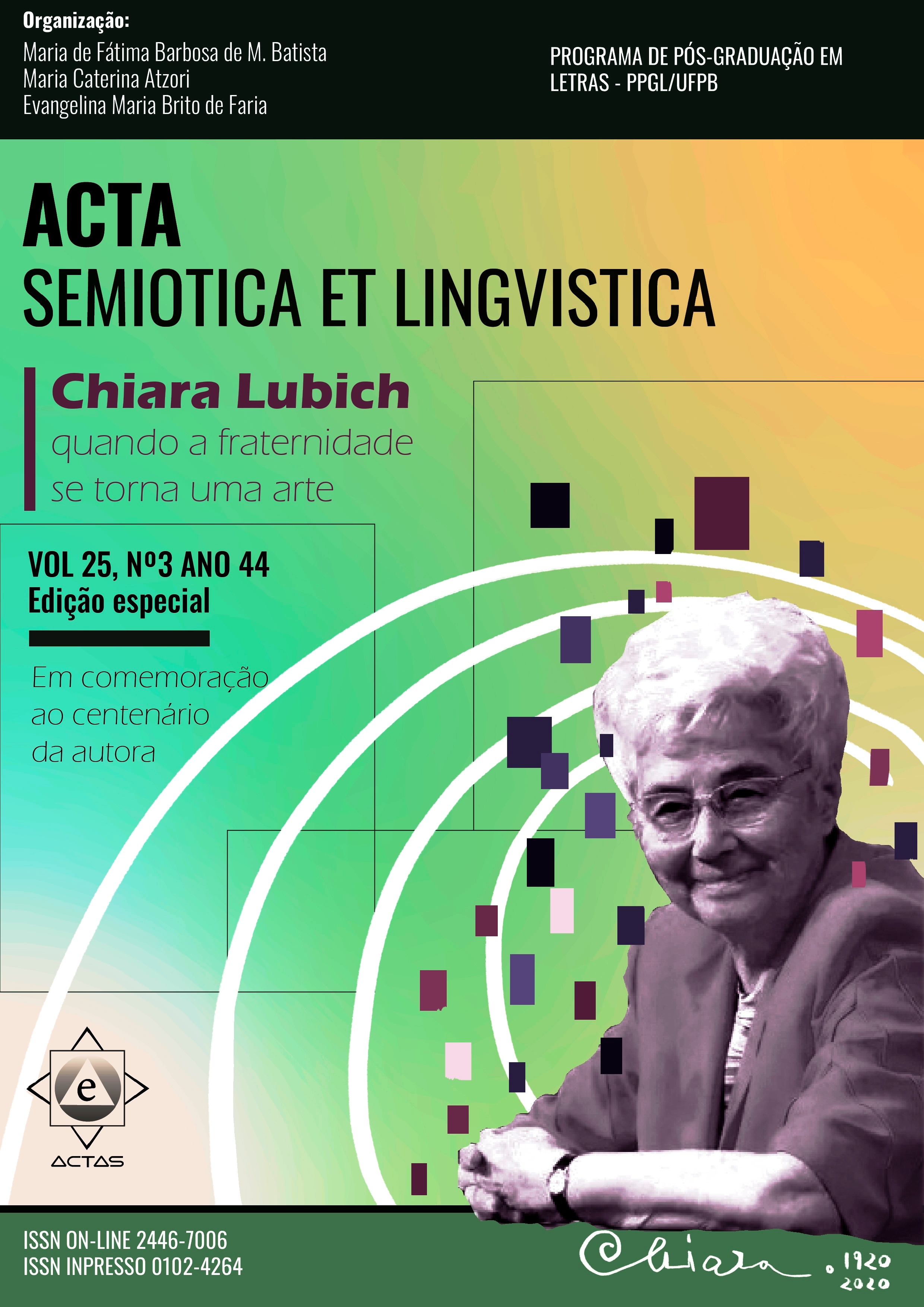
For Interational Linguistics, language is a place of communicative interaction, through the production of meaning between interlocutors, in a given communication situation, constituted by a historical and ideological context. Language users interact as subjects, who occupy social places and speak and hear from these places. For this conception, “Verbal interaction is the fundamental reality of language”. For Bakhtin, communication exists only in the reciprocity of dialogue and is much more than the simple transmission of messages, it is, above all, the constitution of subjects. Constitution of subjects is one of the main actions of language. To consider language as an action is to assume that social practice, which we call language, is inseparable from its ethical, social, economic and cultural consequences. From this perspective, this communication aims to observe, in the text The Resurrection of Rome, by Lubich (1949), the consequences of his saying for life in society. Chiara Lubich (1920-2008) is one of the most representative figures in the intercultural and interreligious dialogue of the 20th century. Founder of the Focolare Movement, she used multiple means of communication to spread her thoughts, leaving a large archive of publications, still partially unpublished. Theoretically, we mainly seek support in Bakhtin (2014) and Austin's pragmatics (1990). Methodologically, we will make a bibliographic path. It is hoped to consolidate the vision of language as an action and to show its importance in building more solid relationships, anchored in a discourse, which finds support in the actions carried out in society.
Keywords: Language, Action, Lubich.
Downloads
Downloads
Published
How to Cite
Issue
Section
License
Declaração de Direito Autoral
Os artigos submetidos a revista Acta Semiotica et Lingvistica estão licenciados conforme CC BY. Para mais informações sobre essa forma de licenciamento, consulte: http://creativecommons.org/licenses/by/4.0
A disponibilização é gratuita na Internet, para que os usuários possam ler, fazer download, copiar, distribuir, imprimir, pesquisar ou referenciar o texto integral dos documentos, processá-los para indexação, utilizá-los como dados de entrada de programas para softwares, ou usá-los para qualquer outro propósito legal, sem barreira financeira, legal ou técnica.
1) Autores mantém os direitos autorais e concedem à revista o direito de primeira publicação, com o trabalho simultaneamente licenciado sob a Licença Creative Commons Attribution que permite o compartilhamento do trabalho com reconhecimento da autoria e publicação inicial nesta revista.
2) Autores têm autorização para assumir contratos adicionais separadamente, para distribuição não-exclusiva da versão do trabalho publicada nesta revista (ex.: publicar em repositório institucional ou como capítulo de livro), com reconhecimento de autoria e publicação inicial nesta revista.
3) Autores têm permissão para publicar e distribuir seu trabalho online (ex.: em repositórios institucionais ou na sua página pessoal) a qualquer ponto antes ou durante o processo editorial, já que isso pode gerar alterações produtivas, bem como aumentar o impacto e a citação do trabalho publicado.


