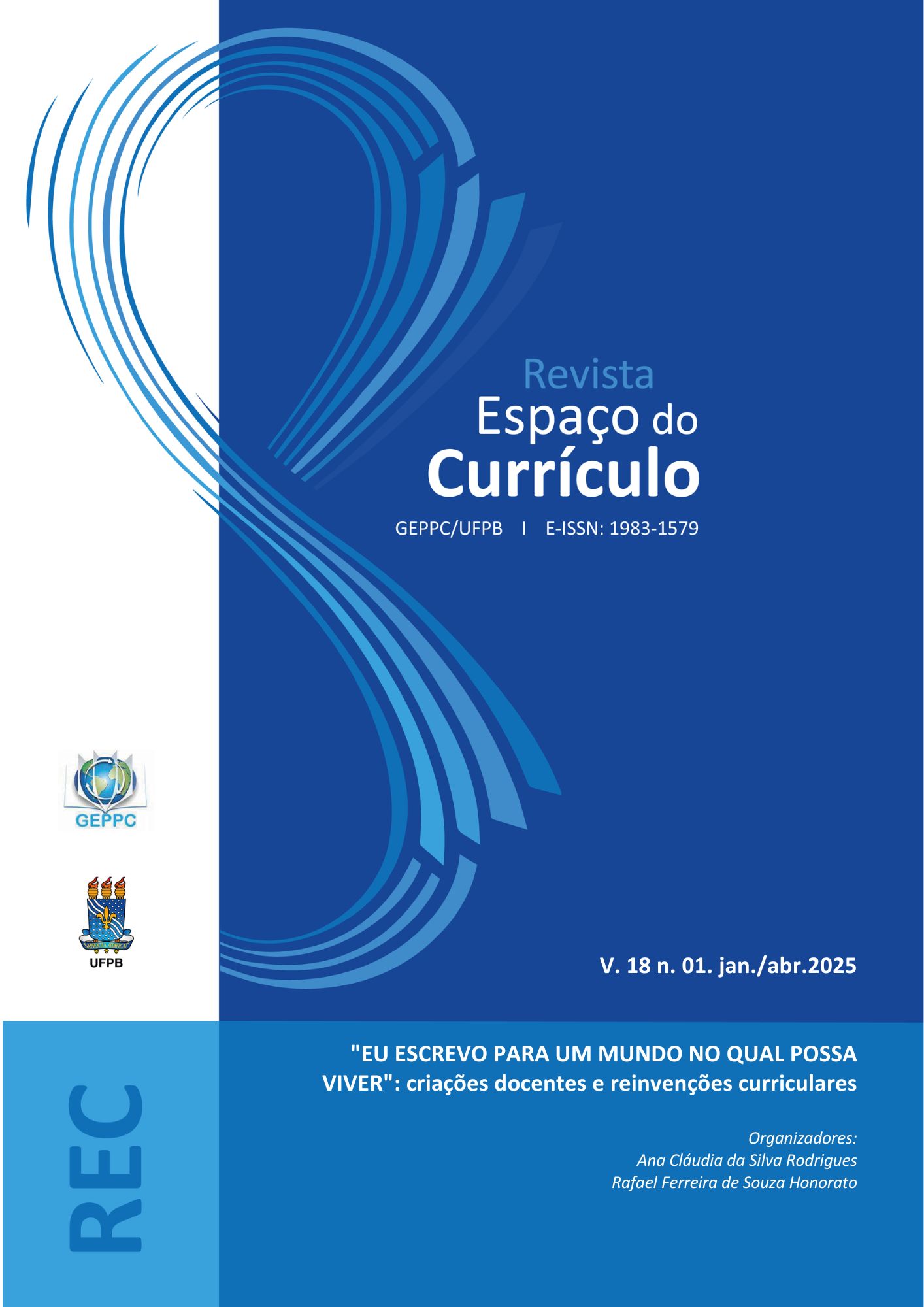
CITIZENSHIPS, CONVERSATIONS AND CURRICULUMS
sparks of an everyday fabric
DOI:
https://doi.org/10.15687/rec.v18i1.70457Keywords:
Curriculum, Daily Routine, Citizenship, EmancipationAbstract
This article seeks to examine and reflect on the connection between the right to education and citizenship today, through educational practices carried out by teachers and students in schools. By closely observing the classroom routine, it was possible to understand how curricula are constructed and applied, and how they relate to society, often diverging from official pedagogical proposals. The development of a more democratic and civil society requires a change in the educational culture, based on cooperation between individuals and the diversity of learning methods. Based on the ideas of research in/of/with everyday life, the importance of everyday activities stands out, considering the diversity and peculiarities of the individuals involved in the curricula designed and practiced. Assimilating and including different worldviews therefore implies recognizing and valuing the subjects themselves in the creation of knowledge, in addition to promoting collaboration and dialogue essential for the development of people who are more aware and engaged in social change. The suggested project is committed to the interaction and dynamic relationship between learning theories and everyday practices in the educational context, becoming a fundamental tool for understanding, valuing and disseminating knowledge beyond academic borders.
Downloads
References
ALVES, Nilda. Compassos e descompassos do fazer pedagógico. In: GARCIA, Alexandra; OLIVEIRA, Inês Barbosa de. (Orgs.). Nilda Alves: praticantepensante de cotidianos. Belo Horizonte: Autêntica Editora, 2015.
ARENDT, Hannah. A condição humana. 12a ed. Rio de Janeiro: Forense Universitária, 2015.
ARENDT, Hannah. Entre o passado e o futuro. Trad. Mauro W. Barbosa. 7ª ed. São Paulo: Perspectiva, 2013.
ARISTÓTELES. Política. 3a ed. Tradução de Mário da Gama Kury. Brasília: Editora Universidade de Brasília, 1997.
BENEVIDES, Maria Victoria. Educação para a democracia. Lua Nova, n. 38, dez., 1996, p. 223-237.
BRASIL. [Constituição (1988)]. Constituição da República Federativa do Brasil de 1988. Brasília, DF: Presidência da República, [2023]. Disponível em: https://www.planalto.gov.br/ccivil_03/constituicao/constituicao.htm. Acesso em: 10 dez. 2024.
BOBBIO, Noberto. O Futuro da Democracia: uma defesa das regras do jogo, Rio de Janeiro: Paz e Terra, 2015.
CERTEAU, Michel de. A invenção do cotidiano: 1. Artes de Fazer. Petrópolis: Vozes, 2012.
COVRE, Maria de Lourdes Manzini. O que é Cidadania. São Paulo: Brasiliense, 2003.
DALLARI, Dalmo de Abreu. Elementos de Teoria Geral do Estado. 25ª ed. São Paulo: Saraiva, 2005.
DAL RI JÚNIOR, Arno. Evolução histórica e fundamentos políticos-jurídicos da cidadania. In: DAL RI JÚNIOR, Arno; OLIVEIRA, Odete Maria. (Orgs.) Cidadania e nacionalidade: efeitos e perspectivas - nacionais, regionais e globais. Ijuí: Unijuí, 2002. p. 25-83.
GALLO, Sílvio. Filosofia, educação e cidadania. In: PEIXOTO, Adão José (Org.). Filosofia, Educação e Cidadania. 2a ed. Campinas: Editora Alínea, 2004. p. 136.
MORIN, Edgar. Os sete saberes necessários à educação do futuro. 2 ed., São Paulo: Cortez; Brasília: Unesco, 2000.
MORIN, Edgar. Ciência com consciência. 8a ed. Rio de Janeiro: Bertrand Brasil, 2005.
NOGUEIRA, Marco Aurélio. Em defesa da política. São Paulo: Editora Senac, 2001.
OLIVEIRA, Inês Barbosa. O Currículo como criação cotidiana. Petrópolis, Rio de Janeiro: DP et Alli, 2012.
OLIVEIRA, Inês Barbosa. Utopias praticadas: justiça cognitiva e cidadania horizontal na escola pública. Revista Instrumento. Juiz de Fora, v. 15, n. 2, jul./dez. 2013, p. 191-201. Disponível em: https://periodicos.ufjf.br/index.php/revistainstrumento/article/view/18872. Acesso em: 25 de jan. 2024.
PASSOS. José Joaquim Camon de. Cidadania tutelada. Revista do Processo, São Paulo, v. 18, n. 72, p. 124/143, out/dez. 1993.
PINSKY, Jaime.; PINSKY, Carla Bassanezi. (Org). História da cidadania. 6a ed. São Paulo: Contexto, 2012.
REIS, Graça; GONÇALVES, Rafael Marques; RIBEIRO Tiago; RODRIGUES, Allan. Estudos com os cotidianos e as rodas de conversação: pesquisa político-poética em educação. Revista Reflexão e Ação, Santa Cruz do Sul, v. 25, n. 3, p. 68-87, set/dez. 2017. Disponível em: https://online.unisc.br/seer/index.php/reflex/article/view/9748. Acesso em: 25 jan. 2024.
REZENDE FILHO, Cyro de Barros & ĈMARA NETO, Isnard de Albuquerque. Evolução do Conceito de Cidadania. Revista Ciências Humanas. v.7, n. 2, 2001. Disponível em: http://www.unitau.br/prppg/publica/humanas/revista. Acesso em: 27 jan. 2024.
RODRIGUES, Neidson. Educação: Da formação humana à construção do sujeito ético. Educação & Sociedade, vol. 22, n. 76, p. 232-257, 2001.
SANTOS, Boaventura de Souza. Na oficina do sociólogo artesão: aulas 2011-2016. 1ª ed. São Paulo: Cortez, 2018.
SILVA NETO, José Leite. Horizontalidade e verticalidade da cidadania. São Paulo: Bauru, Editora Spessotto, 2016.
Downloads
Published
How to Cite
Issue
Section
License
Copyright (c) 2025 Curriculum Space Journal

This work is licensed under a Creative Commons Attribution 4.0 International License.
By submitting an article to Curriculum Space Journal (CSJ) and having it approved, the authors agree to assign, without remuneration, the following rights to Curriculum Space Journal: first publication rights and permission for CSJ to redistribute this article. article and its metadata to the indexing and reference services that its editors deem appropriate.