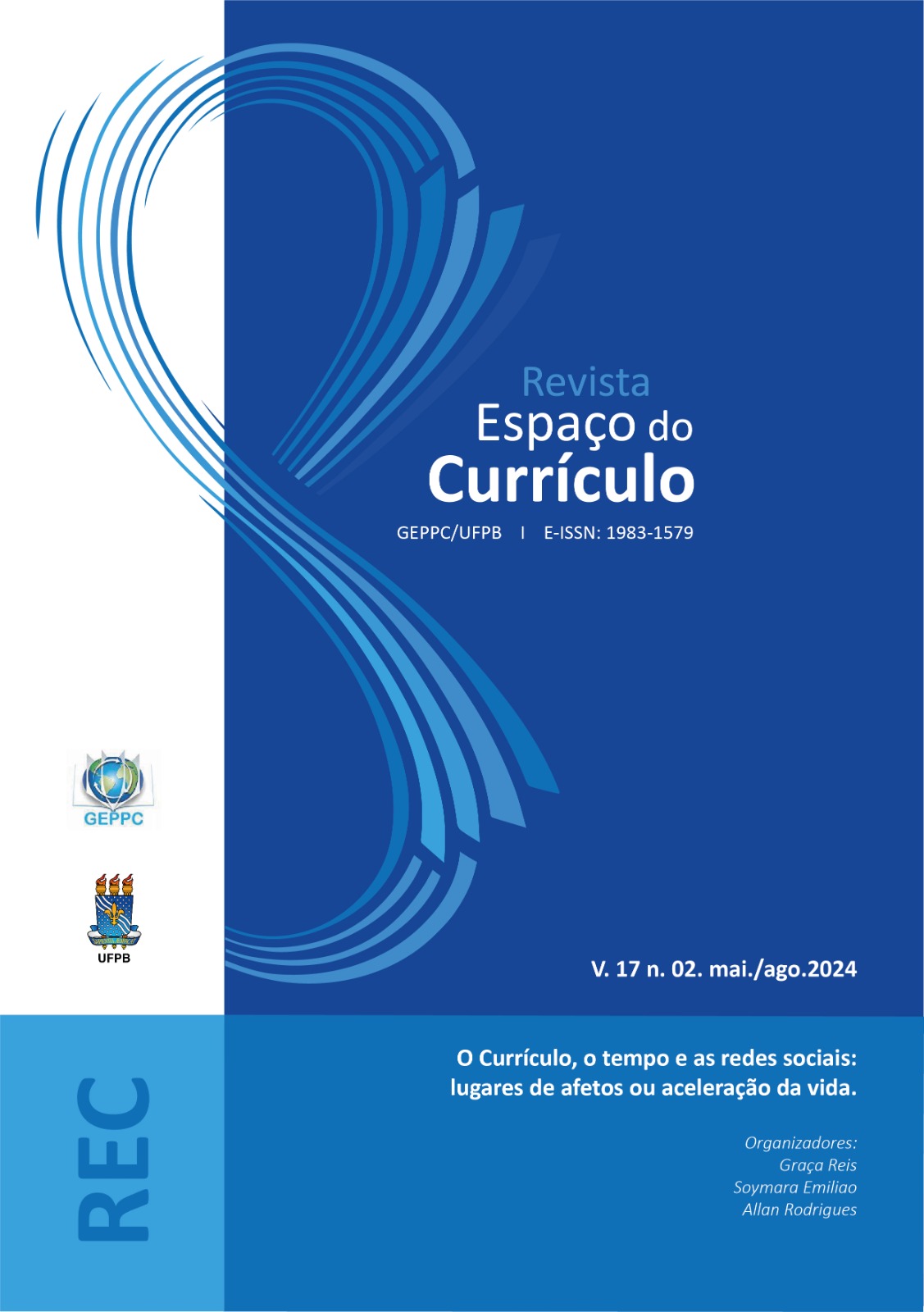
THE CURRICULUM, TIME AND SOCIAL NETWORKS
places of affection or acceleration of life?
DOI:
https://doi.org/10.15687/rec.v17i2.71306Keywords:
Curriculum, Social Networks, TimesAbstract
This proposal for a thematic dossier aims to discuss the ways and means produced in the gaps and fissures of the curricula that are circulating in schools, in the face of the acceleration of the world, the fragmentation of attention and the interests that are becoming accustomed to the times of social networks. What are the escapes from the curricular creations that are created by school practitioners (Certeau, 1994), in the face of time that seems to be getting shorter and shorter or just for likes? Thinking about the curriculum from another temporality means deconfiguring a formation that for a long time was considered ideal, that is, a Eurocentric model of thinking-doing-knowing education as a space of temporality.
Downloads
References
ALVES, Nilda. Decifrando o pergaminho: o cotidiano na escola nas lógicas das redes cotidianas. In: OLIVEIRA, Inês Barbosa; ALVES, Nilda (org.). Pesquisa nos/dos/com os cotidianos das escolas: sobre redes de saberes. Rio de Janeiro: DP et alli, 2001. p. 15-28.
BANCO MUNDIAL. Competências e empregos: uma agenda para a juventude: síntese de constatações, conclusões e recomendações de políticas. Brasília, DF: Banco Mundial, 2018.
BISPO DO SANTOS, Antônio. A terra dá, a terra quer. São Paulo: Ubu Editora, 2023.
BRASIL. Lei nº 13.415, de 16 de fevereiro de 2017. Altera as Leis nº 9.394, de 20 de dezembro de 1996, que estabelece as diretrizes e bases da educação nacional, e 11.494, de 20 de junho de 2007, que regulamenta o Fundo de Manutenção e Desenvolvimento da Educação Básica e de Valorização dos Profissionais da Educação, a Consolidação das Leis do Trabalho – CLT, aprovada pelo Decreto-Lei nº 5.452, de 1º de maio de 1943, e o Decreto-Lei nº 236, de 28 de fevereiro de 1967; revoga a Lei nº 11.161, de 5 de agosto de 2005; e institui a Política de Fomento à Implementação de Escolas de Ensino Médio em Tempo Integral. Brasília, DF: Presidência da República, 2017. Disponível em: https://www.planalto.gov.br/ccivil_03/_ato2015-2018/2017/lei/l13415.htm. Acesso em: 28 ago. 2024.
BRASIL. Ministério da Educação. Base Nacional Comum Curricular. Brasília, DF: MEC, 2018.
CARVALHO, Janete Magalhães. A razão e os afetos na potencialização de “bons encontros” no currículo escolar: experiências cotidianas. In: FERRAÇO, Carlos Eduardo (org.). Currículo e educação básica: por entre redes de conhecimentos, imagens, narrativas, experiências e devires. Rio de Janeiro: Rovelle, 2011. p. 28-52.
CERTEAU, Michel de. A invenção do cotidiano: artes de fazer. Tradução de Ephraim Ferreira Alves. Petrópolis: Vozes, 1994. v. 1.
COUTINHO, Eduardo. O cinema documentário e a escuta sensível da alteridade. Projeto História, São Paulo, n. 15, p. 165-191, abr. 1997.
MARTINS, Leda Maria. Performances do tempo espiralar: poéticas do corpo-tela. Rio de Janeiro: Cobogó, 2021.
MATURANA, Humberto. Emoções e linguagem na educação e na política. Tradução de José Fernando Campos Forte. Belo Horizonte: Ed. UFMG, 2002.
OYĚWÙMÍ, Oyèronké. A invenção das mulheres: construindo um sentido africano para os discursos ocidentais de gênero. Rio de Janeiro: Bazar do Tempo, 2021.
OLIVEIRA, Inês Barbosa. O currículo como criação cotidiana. Petrópolis: DP et Alli, 2012.
ORAÇÃO ao tempo. Intérprete: Caetano Veloso. Compositor: Caetano Veloso. In: CINEMA transcendental. Intérprete: Caetano Veloso. Rio de Janeiro: PolyGram Studios, 1979. 1 CD, faixa 2.
PAIS, José Machado. Vida cotidiana: enigmas e revelações. São Paulo: Cortez, 2003.
SANTOS, Boaventura de Sousa. O fim do império cognitivo. Belo Horizonte: Autêntica, 2019.
Downloads
Published
How to Cite
Issue
Section
License
Copyright (c) 2024 Curriculum Space Journal

This work is licensed under a Creative Commons Attribution 4.0 International License.
Authors retain copyright over their works published in Revista Espaço do Currículo (REC) and grant the journal the nonexclusive right of first publication under the Creative Commons Attribution 4.0 International License (CC BY 4.0). This license permits the reproduction, distribution, sharing, and adaptation of the content, including translations and commercial uses, provided that appropriate credit is given to the authors and the original publication, a link to the license is provided, and any changes are indicated. Authors may deposit the published version of their works in institutional repositories, personal websites, and other academic platforms, as well as enter into additional nonexclusive distribution agreements, provided that the terms of the adopted license are respected. REC is authorized to make the published works and their metadata available to indexing, digital preservation, and scholarly reference services.