CURRICULUM AS AN ETHICAL-AESTHETIC-POLITICAL-POETIC INVENTION OF TEACHING EXISTENCE
DOI:
https://doi.org/10.15687/rec.v18i1.73655Keywords:
Education, Curriculum, CreationAbstract
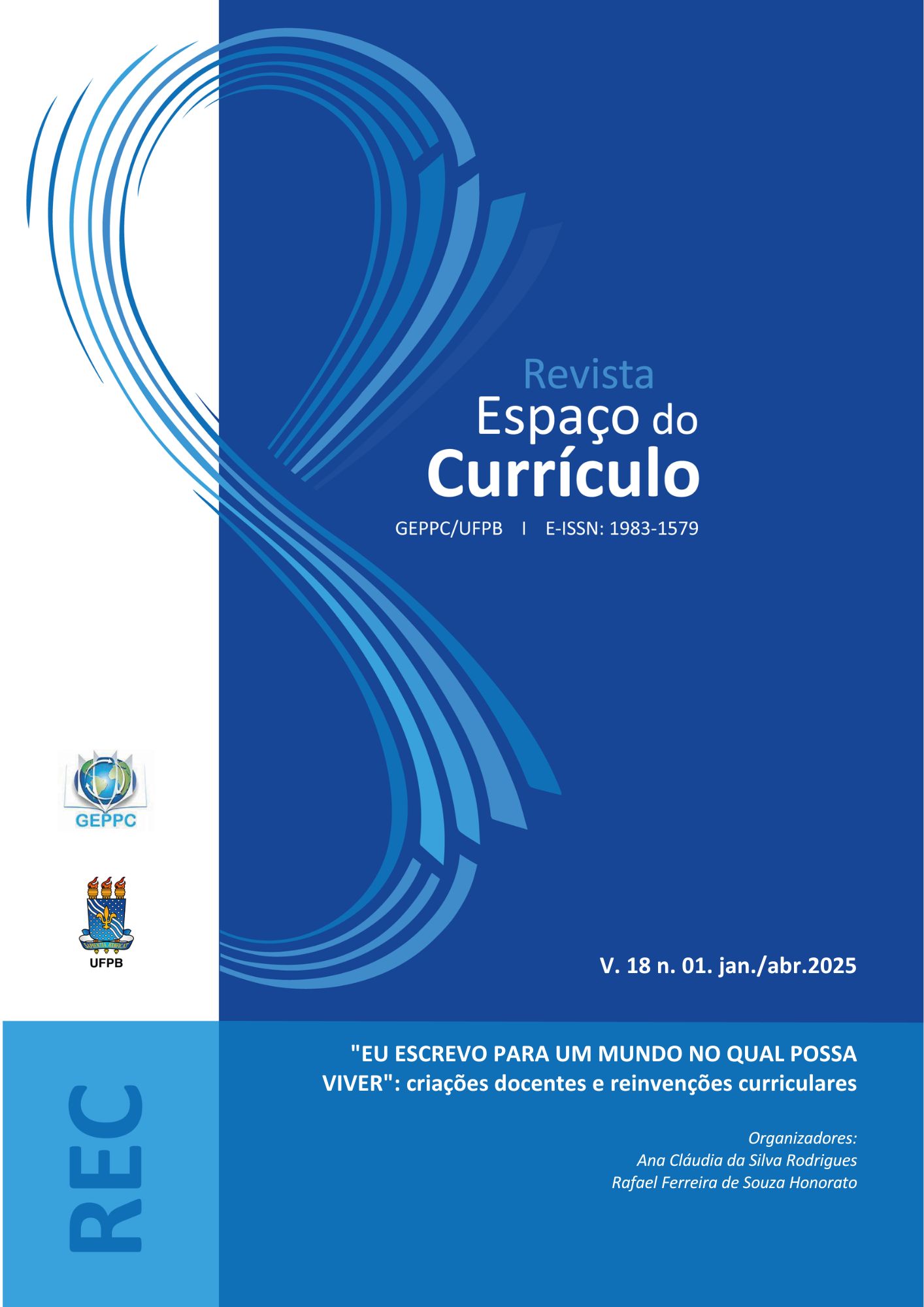
This introduction is anchored in the phrase “I write for a world in which I can live,” by Anayde Beiriz, as a call to writing as a gesture of invention and resistance. More than simply gathering texts around fixed themes, Volume 18, Issue 1, of Revista Espaço do Currículo presents itself as a space of indiscipline, where teaching, writing, and curriculum intersect in experiments that reject what is given, prescribed, and domesticated. Rather than seeking answers, the texts collected here uphold the question “what kind of world do we want to live in?” not as a slogan, but as an urgent and destabilizing inquiry. This dossier does not aim to organize knowledge but to provoke displacements, opening space for curriculum to assert itself as an ethics, aesthetics, politics, and poetics of existence. This introduction is not just an invitation to read but an invitation to cross over, where writing does not merely represent the world but recreates it.
Downloads
References
Não se aplica
Downloads
Published
How to Cite
Issue
Section
License
Copyright (c) 2025 Curriculum Space Journal

This work is licensed under a Creative Commons Attribution 4.0 International License.
Authors retain copyright over their works published in Revista Espaço do Currículo (REC) and grant the journal the nonexclusive right of first publication under the Creative Commons Attribution 4.0 International License (CC BY 4.0). This license permits the reproduction, distribution, sharing, and adaptation of the content, including translations and commercial uses, provided that appropriate credit is given to the authors and the original publication, a link to the license is provided, and any changes are indicated. Authors may deposit the published version of their works in institutional repositories, personal websites, and other academic platforms, as well as enter into additional nonexclusive distribution agreements, provided that the terms of the adopted license are respected. REC is authorized to make the published works and their metadata available to indexing, digital preservation, and scholarly reference services.